FreeStory: Training-Free Character Consistency
for Free-Form Visual Storytelling
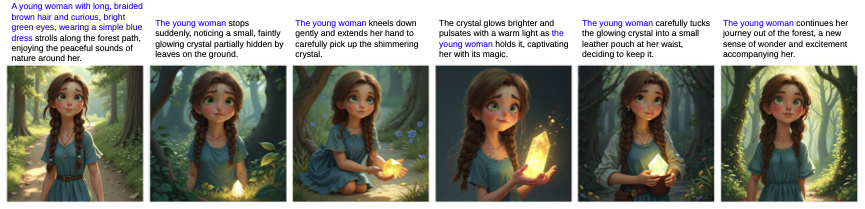
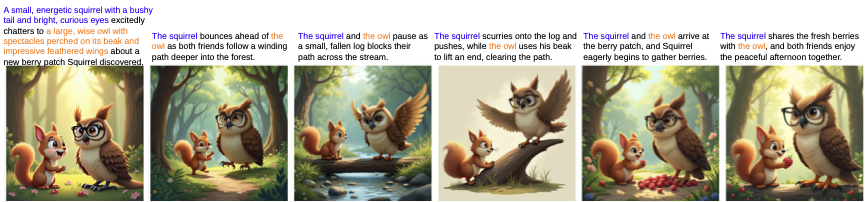
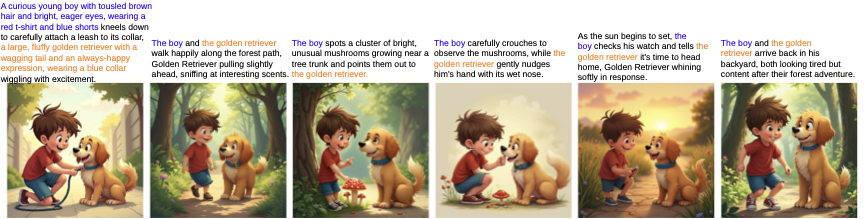
Examples from FreeStoryBench.
The benchmark includes both
single- and multi-character stories under free-form prompts.
Abstract
Visual storytelling aims to generate image sequences that are both aligned with narrative prompts and consistent in character appearance across images. Recent training-free methods improve character consistency by reusing attention features, but rely on structured prompts where full character descriptions are repeated in every prompt. This assumption simplifies the task but deviates from natural storytelling, where characters are typically introduced once and later referred to using pronouns or type-based expressions. We propose FreeStory, a training-free framework that reformulates character consistency under free-form prompts as entity-grounded feature reuse. Our method associates reference mentions with their corresponding character descriptions and combines dynamic character masks, correspondence-aware feature matching, key-value injection, and query blending to preserve identity while retaining generation diversity. We also introduce FreeStoryBench, a benchmark for this setting that includes both single- and multi-character stories. Experiments show that FreeStory achieves state-of-the-art performance among training-free methods on structured benchmarks and stronger overall consistency over baselines under free-form prompts.
Method Overview
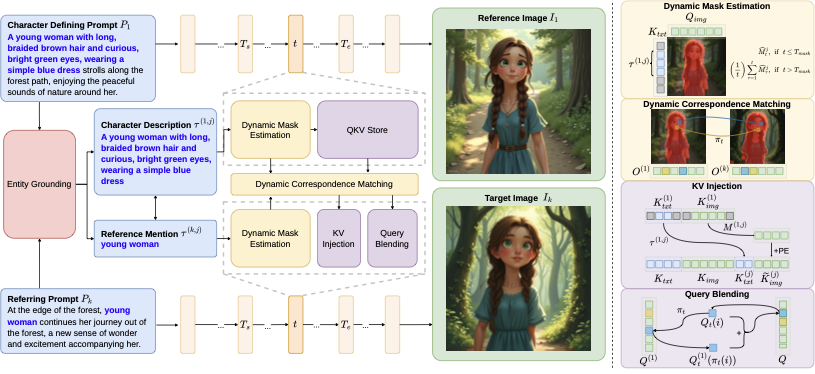
Overview of our proposed FreeStory framework. Given a character-defining prompt P1, the model generates the reference image I1 and uses entity grounding to associate the character description τ(1,j) with reference mentions τ(k,j) in referring prompt Pk for character c(j). During generation of I1, we extract cross-attention weights to compute the dynamic mask M̃t(1,j) and store the corresponding key, value, and query features in a QKV bank. Given a referring prompt Pk, the model generates the target image Ik and extracts its character mask. Token-level correspondence between I1 and Ik is established within the masks, enabling correspondence-guided key-value injection with positional re-encoding (+PE) and query blending. This process propagates character identity from I1 to Ik, ensuring consistent appearance under free-form prompts.
BibTeX
@article{dong2026freestory,
  title={FreeStory: Training-Free Character Consistency for Free-Form Visual Storytelling},
  author={Dong, Sibo and Shaheen, Ismail and Bargal, Sarah Adel},
  journal={arXiv preprint arXiv:2606.25079},
  year={2026}
}